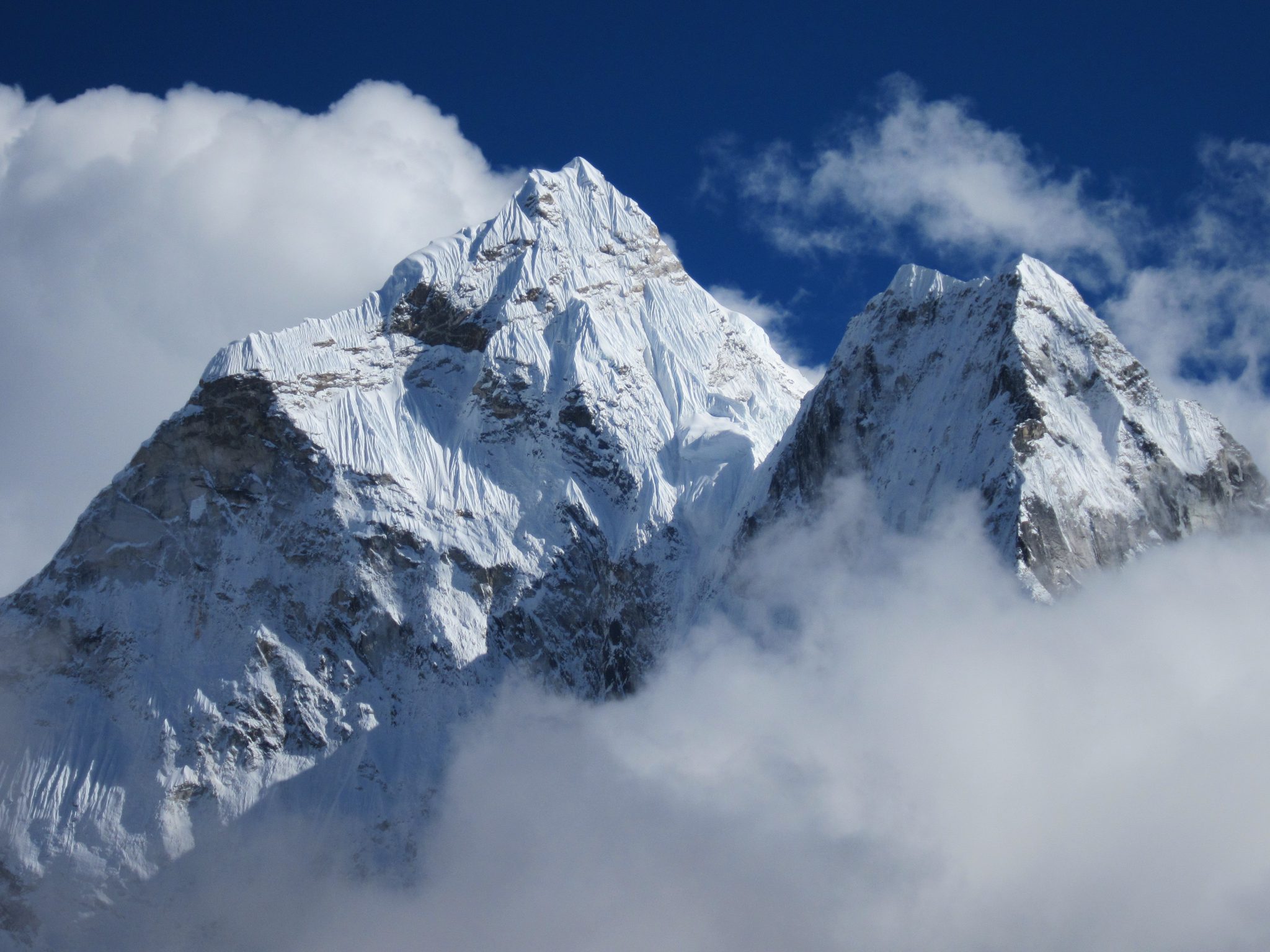
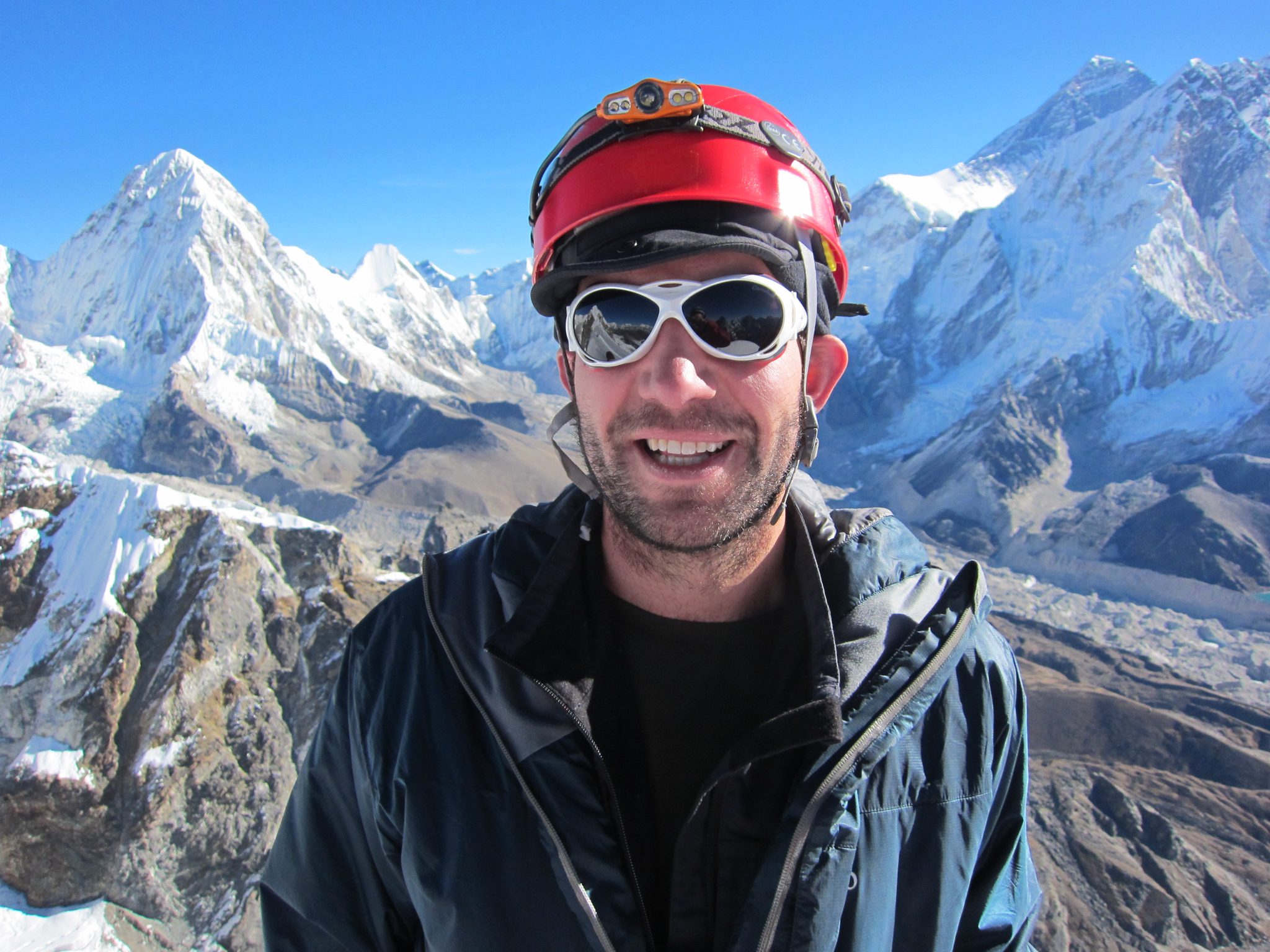
In keeping with the standard practice weather, the skies cleared yesterday as evening turned into night, and I had another go at capturing the starlit mountains. This time it worked rather better - the first photo shows Lhotse and Island Peak under the stars.
The skies were still clear this morning and the views were stunning, but the cloud gradually rolled in as we spent the morning practising the rope techniques we’re going to need later in the trip. We focussed on using the Jumar to ascend a fixed-rope, but also covered abseiling back down and roping up for a glacier-crossing. Most of the stuff was do-able, but Andy seems to expect previous experience of it - I’m quite glad we’re going to have another go tomorrow as I’ve never used a Jumar before. Tomorrow they’re going to be making sure we’ve all go the message, which is reassuring.
The difference between night and daytime temperature here is amazing. As soon as the sun comes up the change is instant and hats, gloves and down jackets are no-longer required. Although the air temperature is still very low, the amount of radiation at this latitude and altitude is enormous, so it suddenly feels much warmer. It’s fairly straight-forward to manage the layering at sunrise and sunset, but it’s hard to know what to wear sometimes, if the sun is going behind clouds every few minutes.
One thing which never warms up is the water in the streams. I did some washing in a bowl this morning then rinsed it out in a stream, and it was freezing! Nice to have some clean clothes though.
While I took some early morning photos today I got talking to a Californian guy who was as amazed as I was by the amount of traffic over the last few days. He’s heading up to a few high passes over the next few days, so is looking forward to some quieter trails.
For some reason Andy didn’t take the group on an acclimatisation walk today, which surprised Mark and me. The usual advice is “climb high, sleep low”, so we were expecting to spend a few hours climbing up one of the valley sides to get used to the lack of oxygen, but Andy’s success-rate on the big climbs is pretty impressive, so we decided to listen to his advice and rest. Later on he said a short climb wouldn’t be the end of the world, so we climbed for about half an hour up the west side of the valley, and took several hundred photos of Ama Dablam as the view through the clouds came and went.
Since then I’ve bought a pen, written some diary and read. Martin has lent me The Reluctant Fundamentalist, which is excellent.
I really don’t like AMS. I’ve had a headache and stomach problems since we arrived at Pokalde base camp two days ago, and would love to be down at sea-level right now. I’ve actually been questioning whether I really enjoy this kind of thing as much as I thought - I can’t honestly say today’s ascent of Pokalde has left me with any positive emotions, other than relief that it’s over. I’m certainly not feeling inclined to book any more higher or colder expeditions.
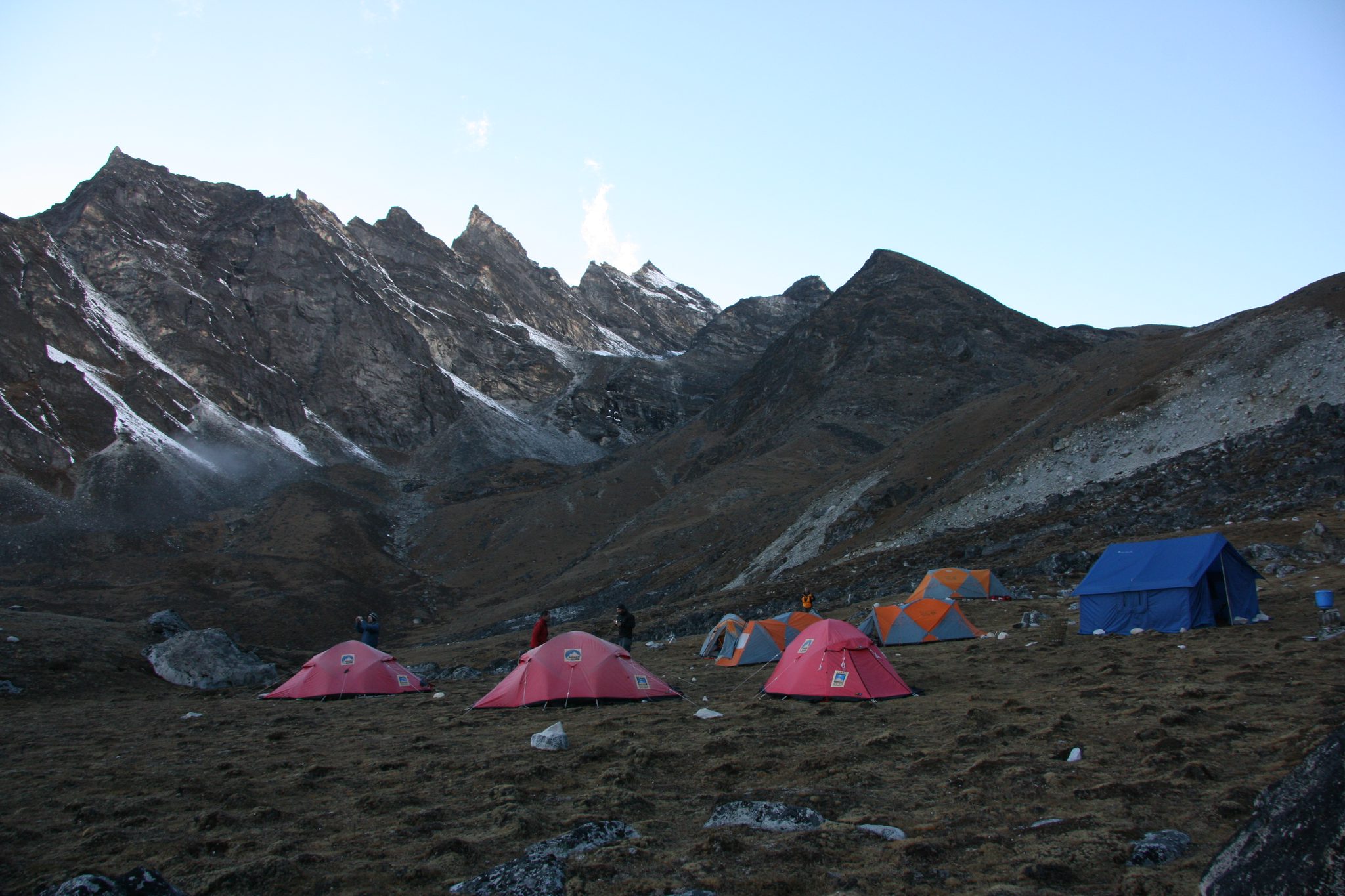
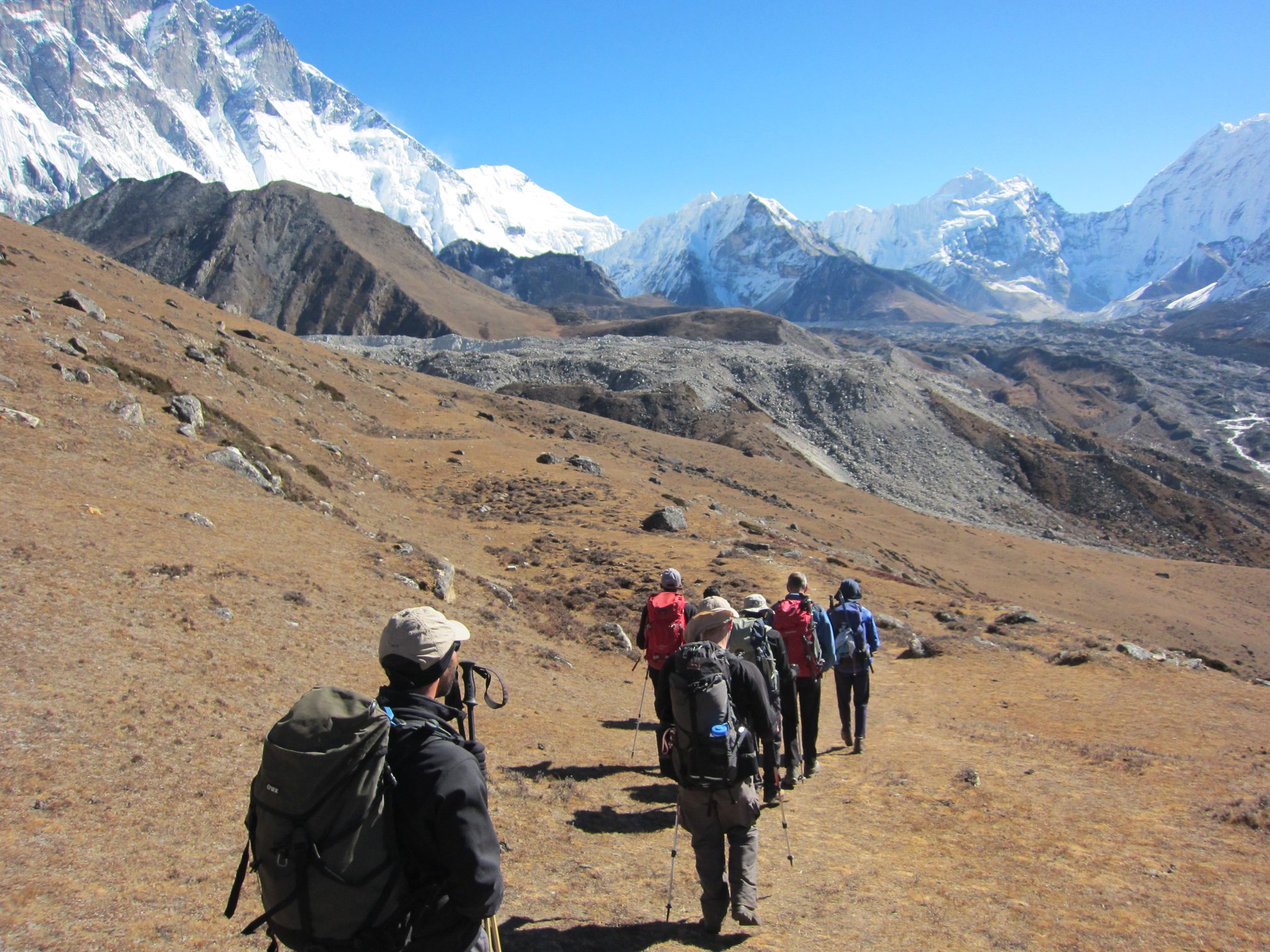
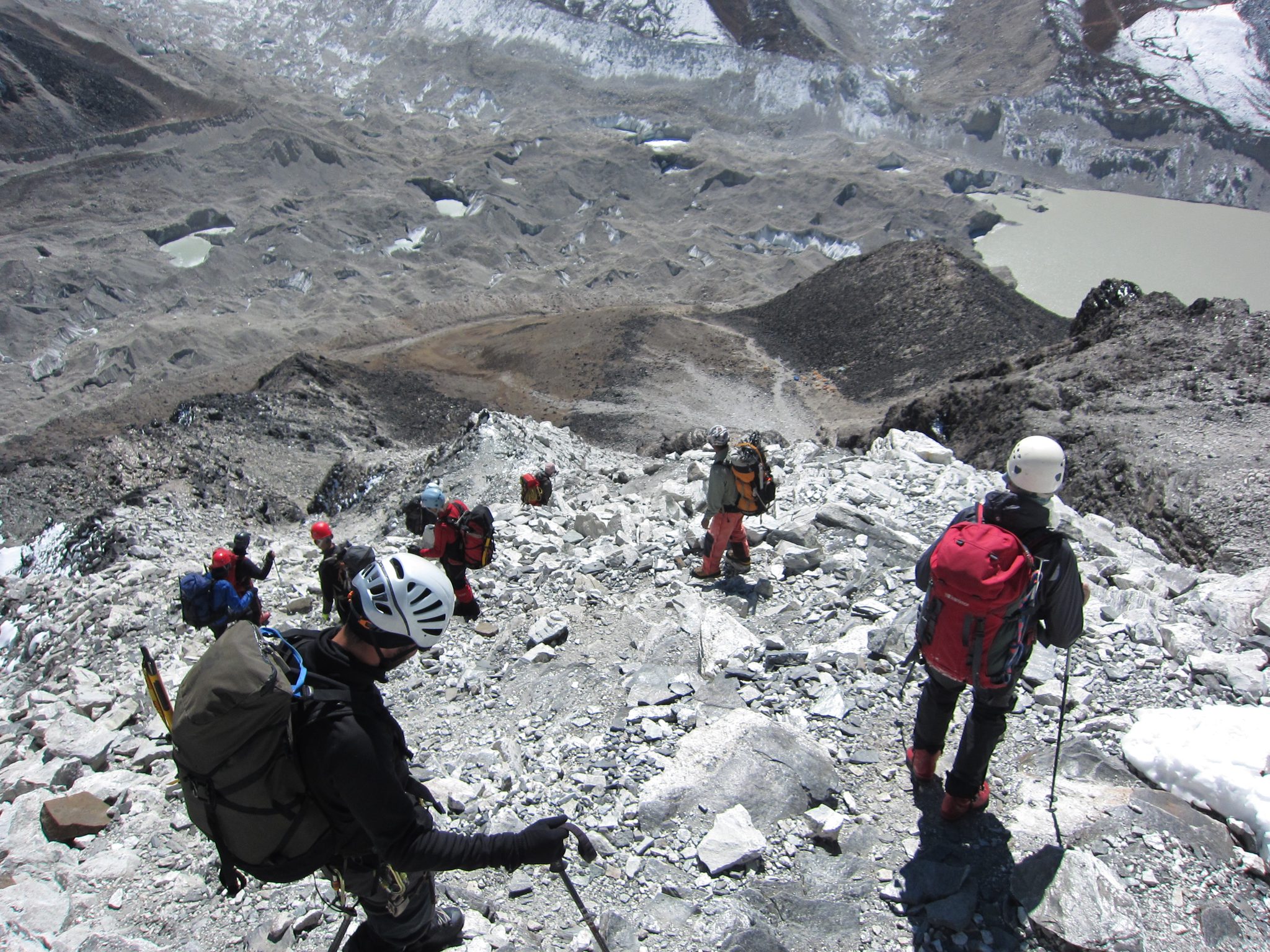
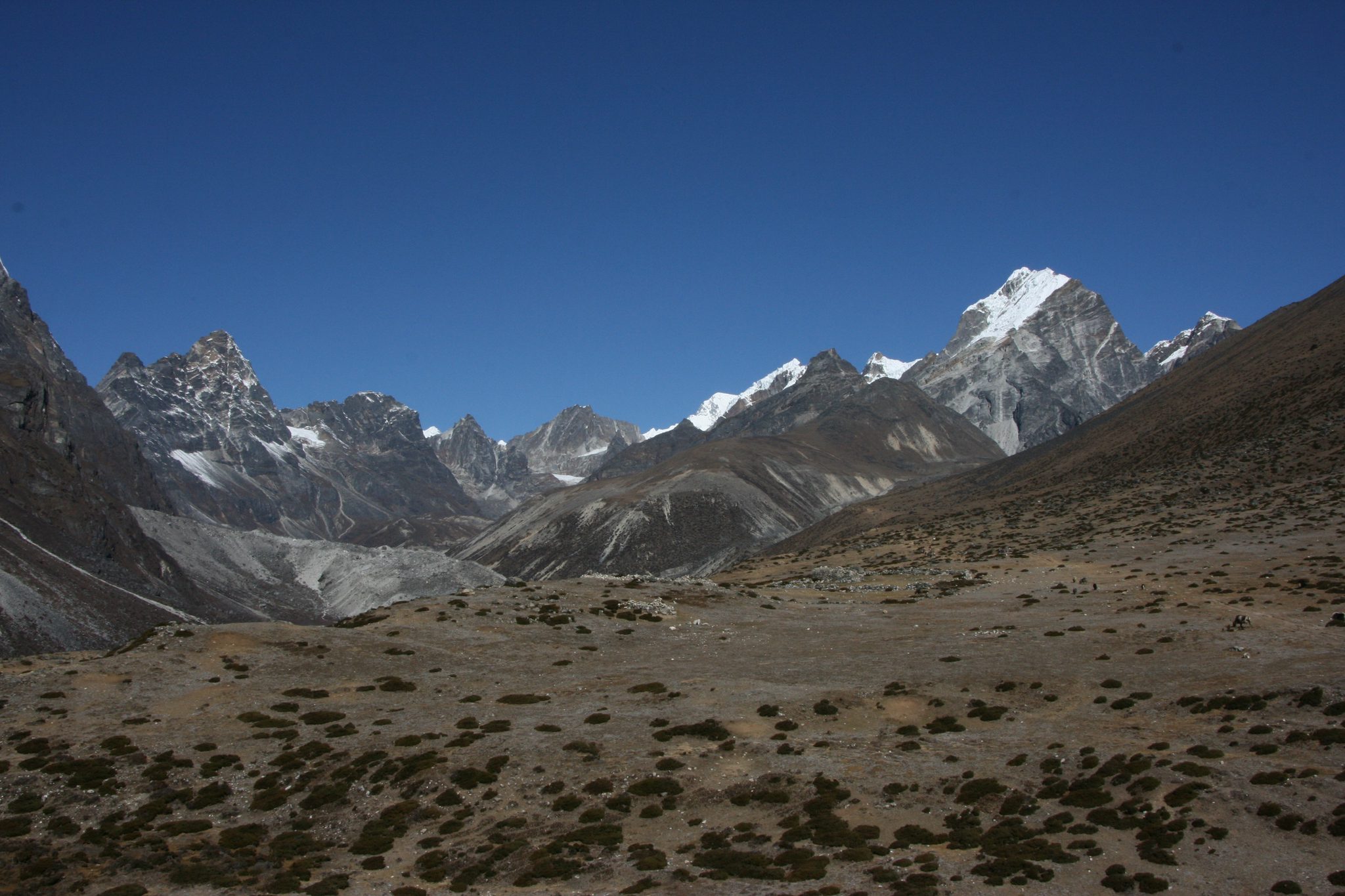
We left Dingboche on Thursday in pretty good spirits, rested and with a with some clean clothes. It wasn’t a long day, as we’d climbed the 600m up to base camp (first photo) by late morning, and the climbing felt pretty easy too.
Lunch was very impressive, considering the altitude and the fact that it was prepared in a cave! After it, we did some more fixed-rope training. The porters rigged up a few anchors and we Jumar’ed up then abseiled down, until we and they were happy that we knew how to clip in and out as we moved past the anchors.
By the time we’d finished the training I was feeling pretty sorry for myself. I had a headache, and was feeling exhausted and also inexplicably annoyed! I lay down for a while and felt a bit better after dinner.
I woke yesterday (Friday) morning still not feeling 100% and struggled a bit with breakfast, but by the time we set out for high camp I was OK and quite enjoyed the climb, chatting with a couple of young American guys we met. Martin and Steve both commented how surprised they were that I’d been able to have a conversation while climbing, but I’d felt fine at the time. Soon after we arrived at high camp though, I began feeling rubbish, and just wanted to lie down.
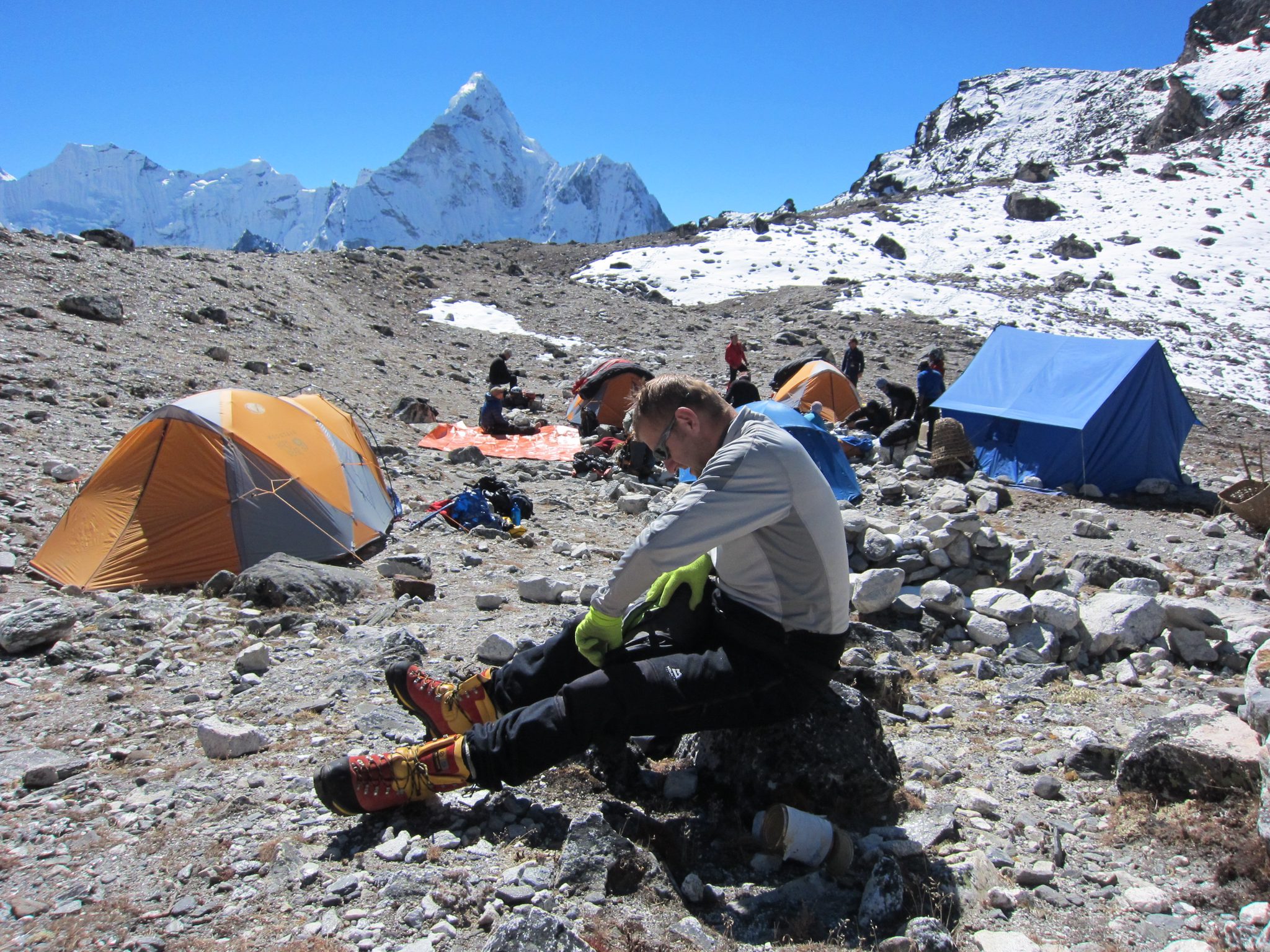
There was no mess-tent at high camp, so lunch was served on a tarp, then dinner in our tents. By that stage we’d organised all our kit for the summit attempt and were wrapped up snugly in our sleeping bags.
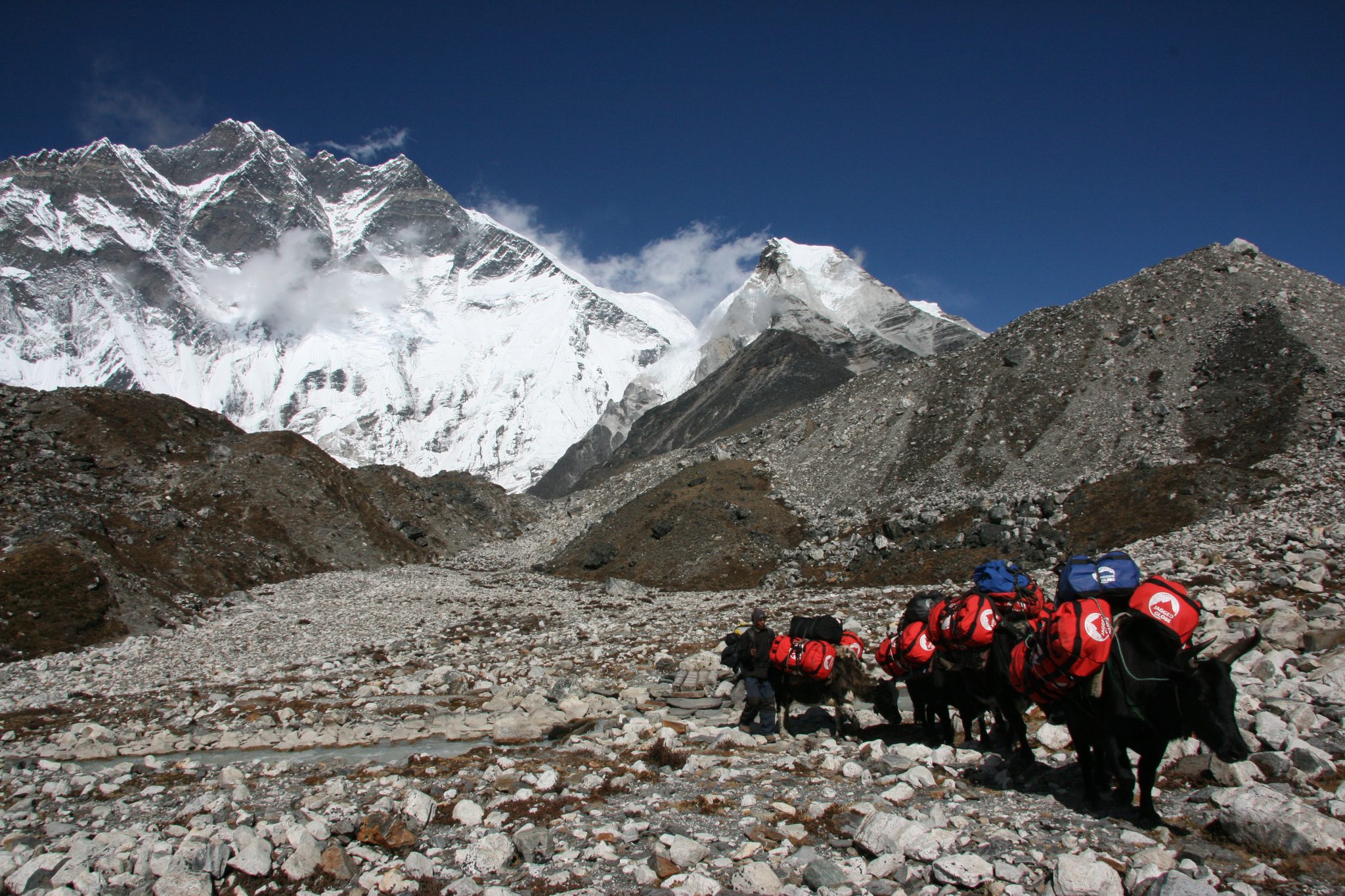
The amount of kit we took up to high camp was a fraction of the total. We’d spent Thursday afternoon at base camp rearranging the kit as most of it stayed behind with the yaks. The porters were mainly carrying the tents and cooking gear, but also carried sleeping bags. The rest of the kit (climbing gear and extra layers of clothing) was carried by us, so was kept to an absolute minimum: we walked up to high camp in the same kit we were going to use on summit day, wearing fleece salopettes, plastic high-altitude boots, etc.
The climbing kit consisted of a harness with a Jumar and spare carabiner (each on a sling) for ascending, and a belay device of some sort for abseiling back down, along with a few emergency spares like prusik loops, another sling and another carabiner or two.
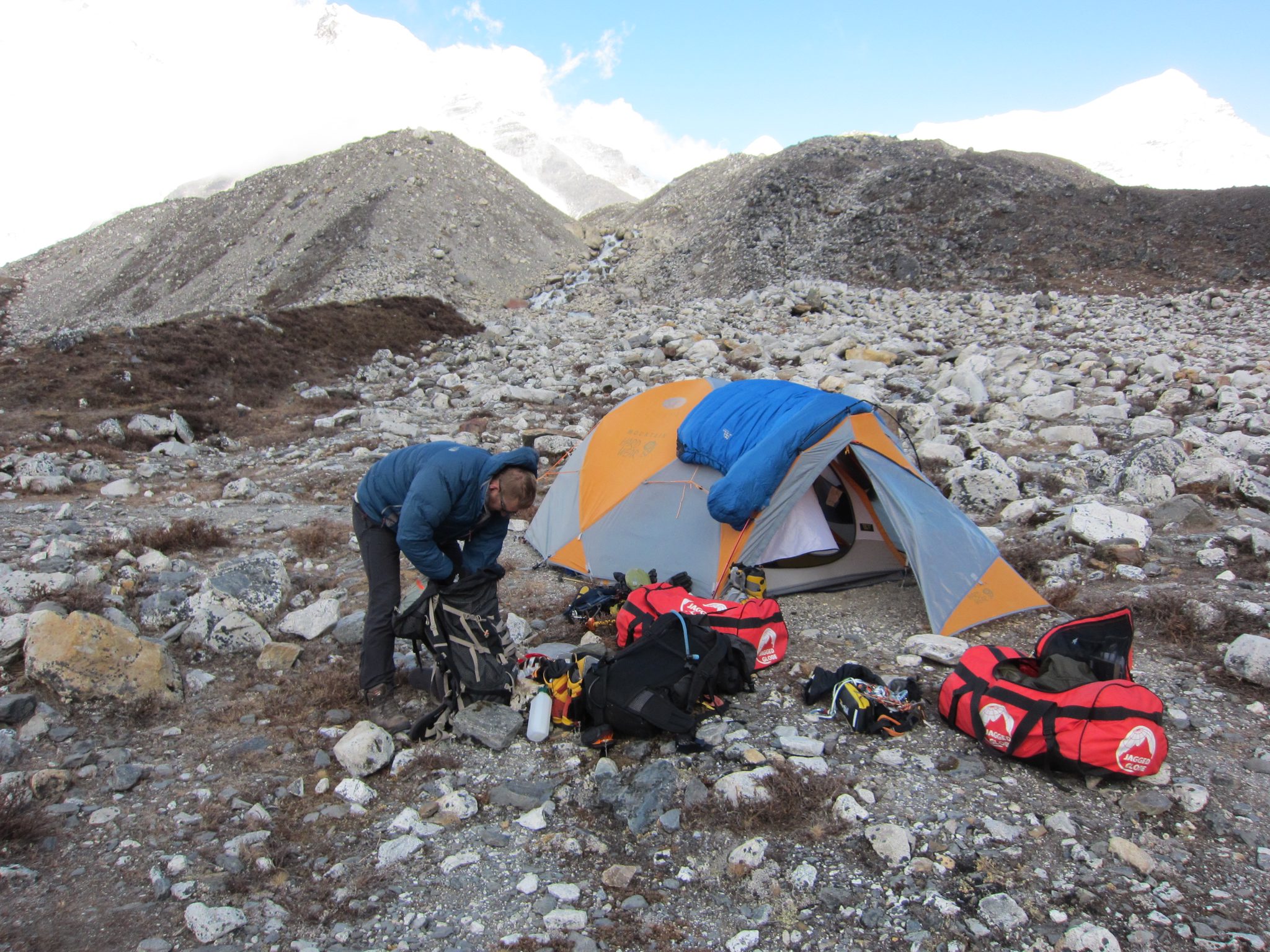
At base camp we’d had two people sharing a three-man tent but, to cut the kit down, we had three in the tents at high camp, so Mark joined Rich and me. We had some banter as we ate our boil-in-the-bag meals, but were all very conscious of the early start, so by 20:00 we were all trying to sleep.
It wasn’t the best night’s sleep, disturbed by the proximity of Rich’s feet and the need to pee during the night, but I successfully managed that without leaving my sleeping bag, so I was quite pleased with myself! Apart from gaining altitude slowly, the only defence against AMS is to drink more water than you think is possible. Unfortunately if you carry this on into the evening then your sleep is punctuated by toilet trips, but if you have a big enough pee bottle then you can avoid the need to put on all your layers and head out into the freezing night.
We were woken at about 03:30 this morning, and plied with hot drinks and porridge. I’m heartily fed up of porridge (which I’ve never liked) and ended up drinking hot water as I don’t like tea and coffee either, so it wasn’t the best breakfast I’ve ever had. I was also still feeling pretty rubbish, and wasn’t as enthusiastic as the other two about leaving the tent.
Eventually I’d pulled on almost every item of clothing I had, and ventured outside. I stuffed the remaining kit in my rucksack, paid a quick visit to the toilet tent, put my harness on and was ready to go. We all had head-torches attached to our helmets, so the traditional snake of lights set off from high camp at about 05:00, heading for the summit of Pokalde.
To begin with I didn’t feel too bad, but gradually got worse as we climbed. I dropped back through the group, feeling nauseous and slow, but luckily not too cold. The route was a mixture of rock and snow, but not enough that we ever put the crampons on. I climbed most of the way with an ice-axe in one hand and a pole in the other, switching hands at every corner to keep the ice-axe in the uphill hand. Every time we stopped it was a huge effore to get going again and I felt very lethargic, but we all kept plodding up and, at the end of a 150m of fixed line, I finally arrived at the summit (5,806m).
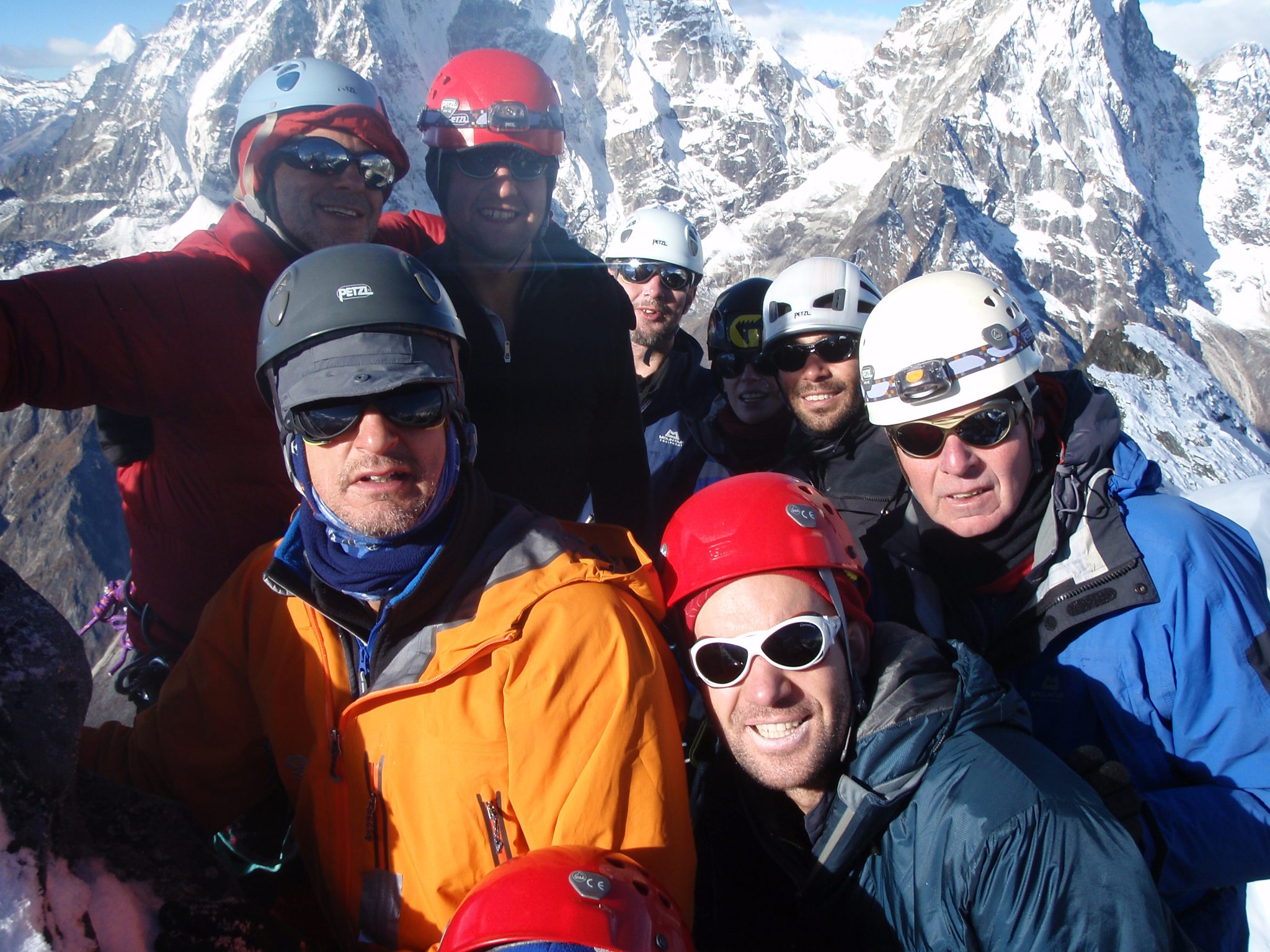
Pokalde’s summit was tiny, so we all clipped into a couple of slings at the top of the fixed line, and Andy took some photos. We didn’t hang around long, and set off back down the fixed line.
Jo and I, having arrived last, lead the group back down, pausing at the end of the rope to wait for the others. Luckily the sun was up and beginning to get quite warm, as we had quite a wait while the rest of the team came down the line, one-by-one. I was feeling rubbish by this stage and couldn’t be bothered taking any photos, which I suspect I’ll regret.
Shortly before I got back to high camp I was walking with Andy and Rich and began feeling even worse. As we were within sight of the tents I warned them I was about to be sick and sent them on, while I stopped to see what happened. Tom and Vanessa arrived just as I was throwing up, and Vanessa said she was glad to see that she wasn’t the only one feeling rough!
Back at high camp we were greeted with soup and hot lemon to rehydrate, then had an hour and a half to pack up out kit before we dropped down to base camp. Packing up was a bit of a struggle, as everyone was feeling a bit rough by this stage.
The walk down wasn’t too bad, but didn’t bring the improvement in health we were hoping for. Since we got back to base camp most people have just slept - Mark seems to be the only person who wasn’t affected by the climb. Martin didn’t feel up to it this morning, but I’m not sure how he’s feeling now as I haven’t seen him.
I’m gradually beginning to feel more normal, but I’m desperately hoping the other two summits won’t feel as bad. At the moment the beach in Miami where I was three weeks ago seems like a different world. What I really want now is a pie, chips, beans and a pint of Bombardier.
I’m feeling a lot better today, both physically and mentally. Today we dropped down from Pokalde Base Camp to Chukhung (4,730m) for lunch then began the climb up towards Island Peak. We’re now at Island Peak Base Camp (4,960m), which is at about the same altitude as Pokalde Base Camp where we were this morning. The camp didn’t feel nearly as cold today as it did two days ago - there was still a layer of frozen condensation on the inside of the tent, but there was no snow outside, just a little frost.
The group was in great spirits this morning, and Thomas and I spent most of the walk down to Chukhung making plans for a Take That cover band. We soon branched out into other groups and had covered everything from U2 to Motorhead by the time we stopped for lunch. Andy wasn’t hugely impressed by the singing, and kept muttering that it was always the 16th day that people started losing the plot.
The experience of climbing up to Pokalde high camp had been enough for Martin. He felt so rough on the way up to the camp that he’d given the summit a miss, then decided that he wasn’t in any state to tackle the two higher summits, so left this morning to walk back down to Lukla with one of the porters. From there he’s heading home to the UK.
The rest of us reached Chukhung at about 10:30 and lay in the sun for an hour and a half, admiring Lhotse’s south face while we ate lunch. Although we’re all feeling a bit more comfortable with the altitude, and the climb was only about 200m, we took the climb up to Island Peak Base Camp very slowly. On the way we passed the Island Peak/EBC team’s base camp about 15 minutes before we reached our site, then found another Jagged Globe team’s tents when we arrived – apparently they’re doing Mera and Island Peak.
Base Camp is by a stream, so I braved the water and washed myself and a few clothes, but the clothes have since frozen on the drying line. We’re not planning on leaving too early tomorrow though, so hopefully they’ll have a chance to thaw and dry out.
Apart from washing, one of the first things we did on arrival was to sort the kit for High Camp and prepare the “attack bag” which the porters will take. This only contains sleeping bags and Thermarests – everything else is either carried in rucksacks (minimal hygiene kit, clothes, climbing gear) or left behind at Base Camp. Normally I’d have left this until the last minute (i.e. tomorrow morning) but Rich is rather more efficient so we sorted the kit out while it was still warm and sunny.
I was struck the other night by the humility of our Sherpas: one of them (Nima Temba) has summitted Everest, and another (Tam Ding) has climbed to over 8,000m on K2, yet they’re happy to bring our meals, clear away plates and fill our water bottles.
I mentioned the continual comparison with the HRP a few days ago, and have since been thinking how luxurious this trip is relative to the HRP. The fact that we have yaks carrying the gear has meant we can throw in the odd spare T-shirt and bottle of deodorant that I left behind when I was carrying everything myself. I’m not sure I’d be super-keen on doing this trip if I had to carry everything myself!
When we were up at Pokalde High Camp the other day, Mark, Rich and I were considering why anyone in their right mind would spend their money on a trip where you end up freezing cold, battling constant headaches and occasional nausea, sleeping on the ground and eating the same thing day after day. At the time we were laughing about it, but I have been wondering why we’re doing this to ourselves! Hopefully the additional time at altitude will show some benefits when we climb Island Peak and Lobouje - if I feel as ill as I did on Pokalde then I don’t think I’ll be doing this again. It wasn’t so much the headache or the nausea, but being annoyed with everyone – I was feeling extremely intolerant. We’re not quite as high as Pokalde Base Camp here, but it’s encouraging to feel so much better.
It was also some comfort to discover that everyone else was destroyed by Pokalde too. On the mountain I felt like I was in a worse state than most people, but by the time we’d got down to Base Camp everyone was in a mess, and the whole team spent the afternoon sleeping. Martin was obviously in a pretty bad way, but last night there were several people coughing, suffering from headaches, etc.
It feels like the calm before the storm at the moment. We’re waiting at IPBC, bags packed, tents down, and the team is filling in time before we set off on the walk to High Camp.
One of the strangest things about this trip is the time spent waiting. Even disregarding the first few weather-affected days in Kathmandu, we’ve still spent the majority of the time sitting in lodges and tents waiting while our bodies acclimatise. Sometimes this time can be spent usefully preparing kit for the next day or rearranging bags for High Camp, but a lot of time is spent chatting, reading and playing games to wile away the time.
Last night was probably the coldest night we’ve had so far, and there was loads of ice inside the tent this morning. I woke up with a bad headache during the night, then again later due to the cold, being uncomfortable, needing the pee-bottle, etc. Once again I’ve been wondering what’s wrong with us that we pay for these experiences…
My spirits were lifted when the sun came up though. I’m still amazed by the temperature change when the sun appears over the mountains – from lying in a freezing tent with ice flakes dropping on you every time you knock the sides, you suddenly find yourself in a rapidly warming tent with melting ice dripping all over the sleeping bags. Luckily the sun has since dried out the sleeping bags and has also managed to melt the washing I did yesterday, though it hasn’t quite dried yet.
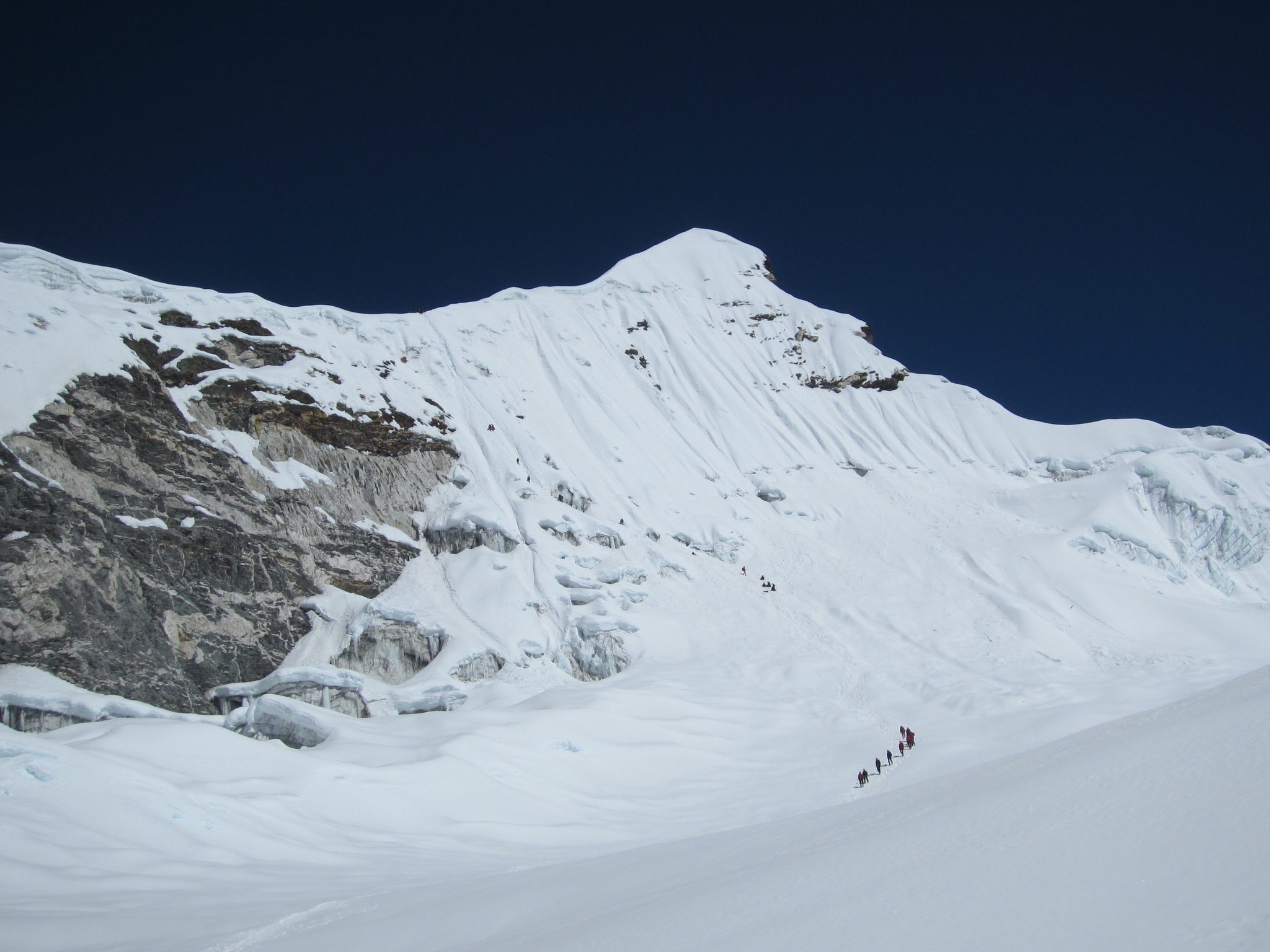
The view from here is incredible. In the foreground is Island Peak, looking pretty daunting 1,200m above us. It’s completely dwarfed, however, by Lhotse, which rises over 3,500m from where we are, to 8,501m We’re looking at the south face, which is one of the biggest cliff faces in the world. Earlier we were wondering if anyone had ever climbed it, and it turns out Tam Ding lead a Japanese team up it a few years ago! Our Sherpas are truly amazing.
Yesterday morning I wrote before we left Island Peak Base Camp. In the afternoon we climbed up to Island Peak High Camp, then this morning eight out of nine clients summitted at 6,189m. We’re now back at IPBC, utterly exhausted but hugely proud and satisfied.
The walk up was flat as far as the “real” IPBC which is situated by the enormous Imje Tsho lake (we used a lower camp, about an hour short of the main one, because the main one is apparently even colder than ours). From there it was a steep climb up to High Camp, which is at about 5,460m.
Rich and I ended up sharing with Andy this time, which was quite entertaining! We rigged up a zip wire for his teddy-bear, and talked a load of nonsense. I didn’t sleep brilliantly though, as the tent was a bit cramped and I was on the downhill side, with gaps underneath me and Andy and Rich rolling down onto me. I think I got a couple of hours sleep sometime after 23:00, but at 01:30 we were woken with “bed tea”.
Departure was scheduled for 03:00, so there wasn’t too much of a rush. We’d sorted out most of our kit the previous afternoon, so just had to eat breakfast and get dressed.
Getting dressed meant sports underwear, long johns, fleece salopettes, base layer, a thin fleece, a Primaloft jacket, a down jacket, two pairs of socks and a pair of plastic double boots, the inners of which had been in the sleeping bag overnight. On top of this there was a Gore-Tex hat, a helmet, gaiters, two pairs of gloves and a harness pre-arranged with Jumar, various karabiners, Prusik loops and a descender, all ready for action. Finally there were walking poles, and a rucksack including ice-axe, crampons, 4 spare pairs of gloves (different types and thicknesses), water, food, waterproofs and some emergency kit.
Luckily the weather was very kind to us again. There was a clear sky, and a full moon lighting up the mountain, but it was also surprisingly warm.
The climb began straight away: from our camp perched on the edge of the steep slope, we just carried on up the slope. We weren’t the first group to set off, and could see head-torches snaking up the path in front of us.
The first two hours were mostly some pretty straightforward scrambling but it was a relief to get a break after fifty minutes. My main concern was hydration, so I was drinking at every opportunity to try and stave off any symptoms of AMS.
After about two hours we reached the glacier. It seemed to take ages for everyone to attach crampons and rope together, but we set off before hypothermia or frost-bite set in, which was a relief. I was at the back of a rope with Tam Ding leading, and Dave and Mark in the middle.
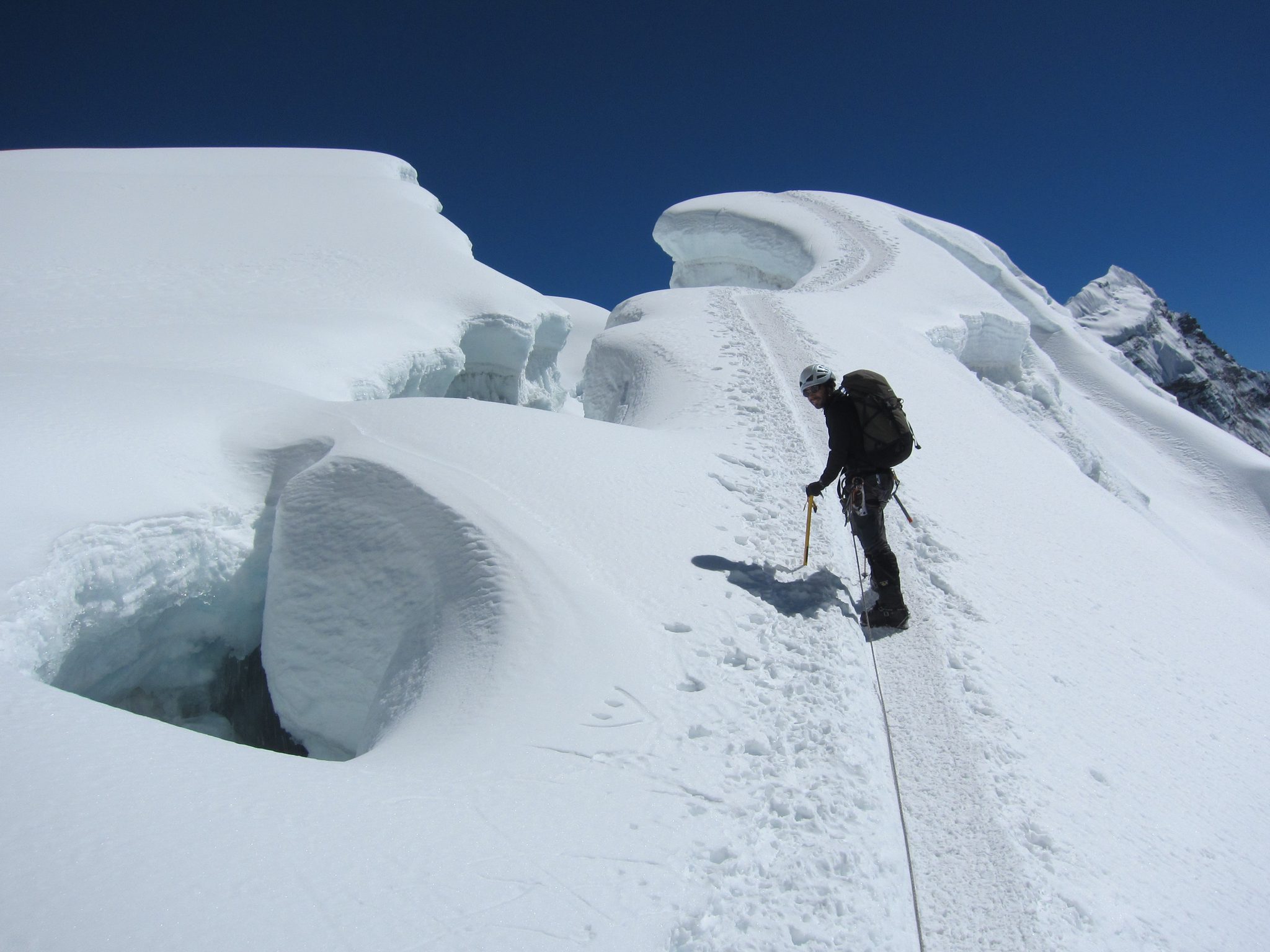
The route across the glacier would look crazy on a map, unless the map showed the enormous crevasses we were walking round. We snaked round the huge holes, some visible, some covered with snow, climbing up and down massive banks of snow-covered ice, gradually zig-zagging in the vague direction of the headwall. As we crossed the glacier the sky began brightening and as we neared the head-wall the promise of sun meant that I stopped worrying about losing my toes from frostbite.
The approach to the headwall became steeper and steeper, until we reached the point where we switched from glacier-travel rope-groups to the fixed line. Crossing the glacier, we’d met a group of Austrians who’d got in the way, but Dowa had put in a fixed line especially for our group, so we didn’t have to fight with the other groups who were sharing another line.
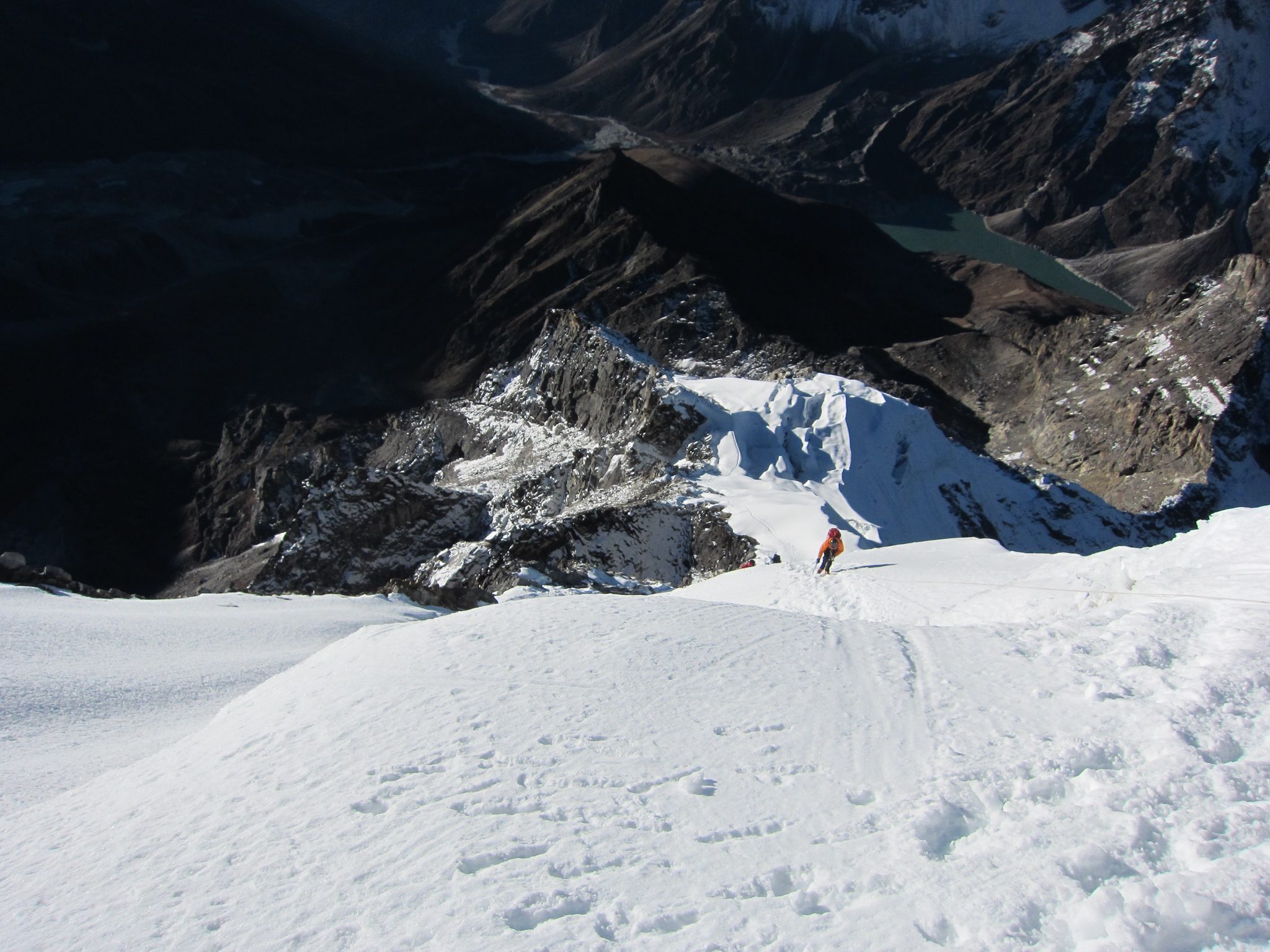
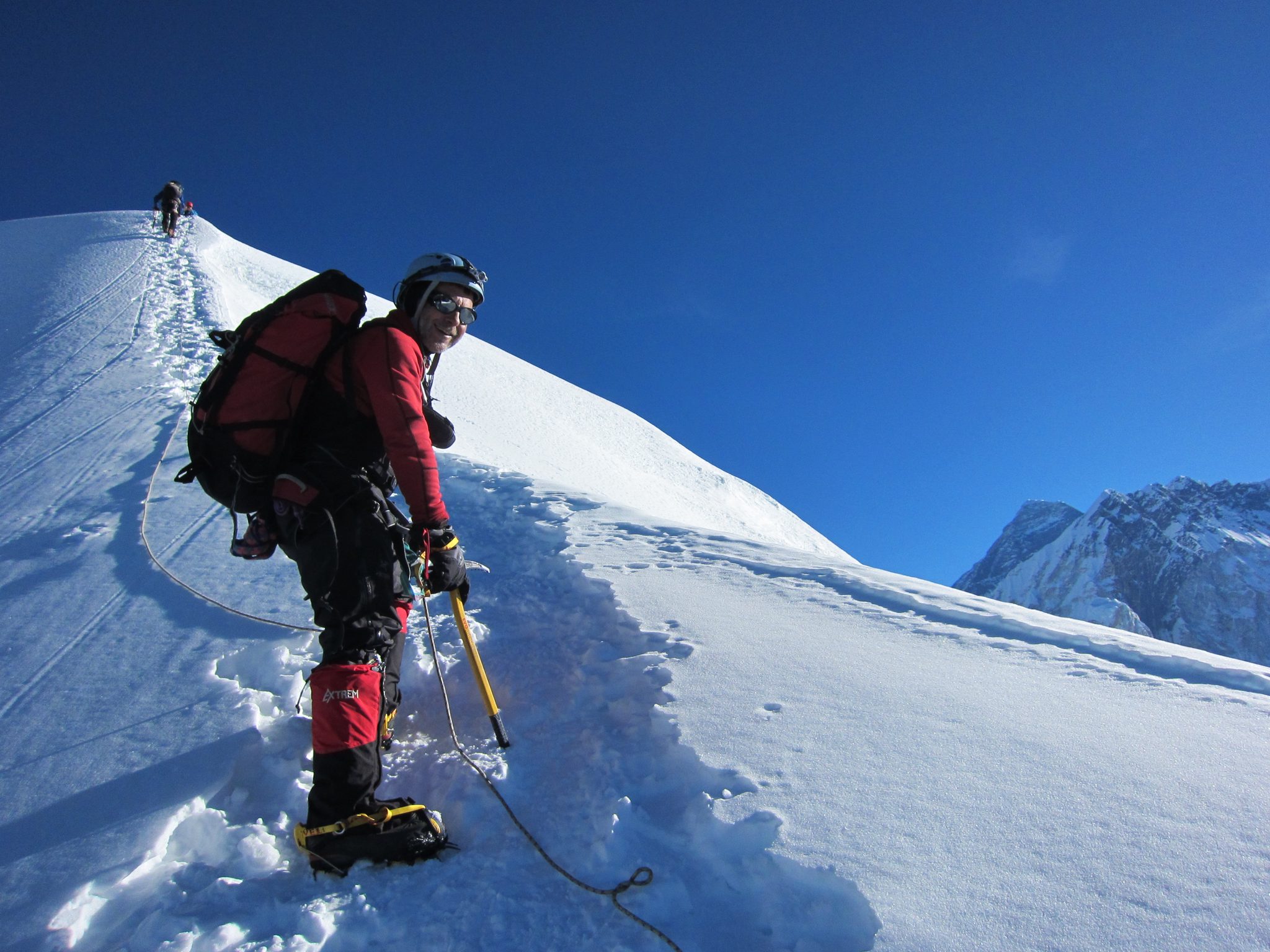
I followed Dave, Mark and Thomas up the headwall. In my right hand I had my axe, and in the left my Jumar. My feet were mainly duck-footed, using the inside points of the crampons, occasionally switching to the front points, which work better on hard, steep surfaces, but are more tiring on the legs.
As we’d crossed the glacier I’d passed my previous altitude record (Kilimanjaro at 5,916m) but the headwall took it way higher: the fixed line ran from about 6,000m up to about 6,120m. I hadn’t read enough about Island Peak to know much about the route in advance, but it was amazing to find oneself climbing a long technical pitch at over 6,000m.
The biggest challenge was the physical one: simply lifting the body up the slope. After initially fighting it I began remembering my early days rock-climbing, stopped trying to haul myself up using the axe and started using the legs to climb, with the axe for balance and the Jumar for protection.
There were two mental challenges. The first was simply believing that you could keep going through the exhaustion, but the arrival of the sun helped with that. The second was navigating round the anchors, where the rope was attached to either the ice or another rope. On reaching an anchor, the safety karabiner is removed from the Jumar and attached to the anchor, so that there’s still some protection while the Jumar is switched from one side of the anchor to the other. Once the karabiner is in place, the Jumar can be released from the lower rope and attached to the upper rope, then the safety karabiner can be unhooked from the anchor and placed back through the handle of the Jumar and around the rope. This is all done in the semi-dark, wearing two pairs of gloves, at around -10°C, having already climbed for several hours up to 6,00m. And if it’s not done correctly, it could have nasty consequences for you and anyone lower down the rope.
I felt ridiculously slow up the headwall. Thomas seemed to be disappearing ahead of me and Tam Ding was right up behind me – so close that I worried that if I slipped I’d land crampons-first on top of him, so I kept the Jumar as tight as possible.
Eventually, after what seemed like a super-human effort, Dowa welcomed me onto the summit ridge, and I transferred to another fixed line for the final climb to the summit. This wasn’t nearly as steep as the headwall but was almost as slow, as we met up with the Austrians again. Both teams were clipping into fixed anchors at the summit, which lead to a queue on the final climb. I certainly didn’t mind the excuse for a breather though!
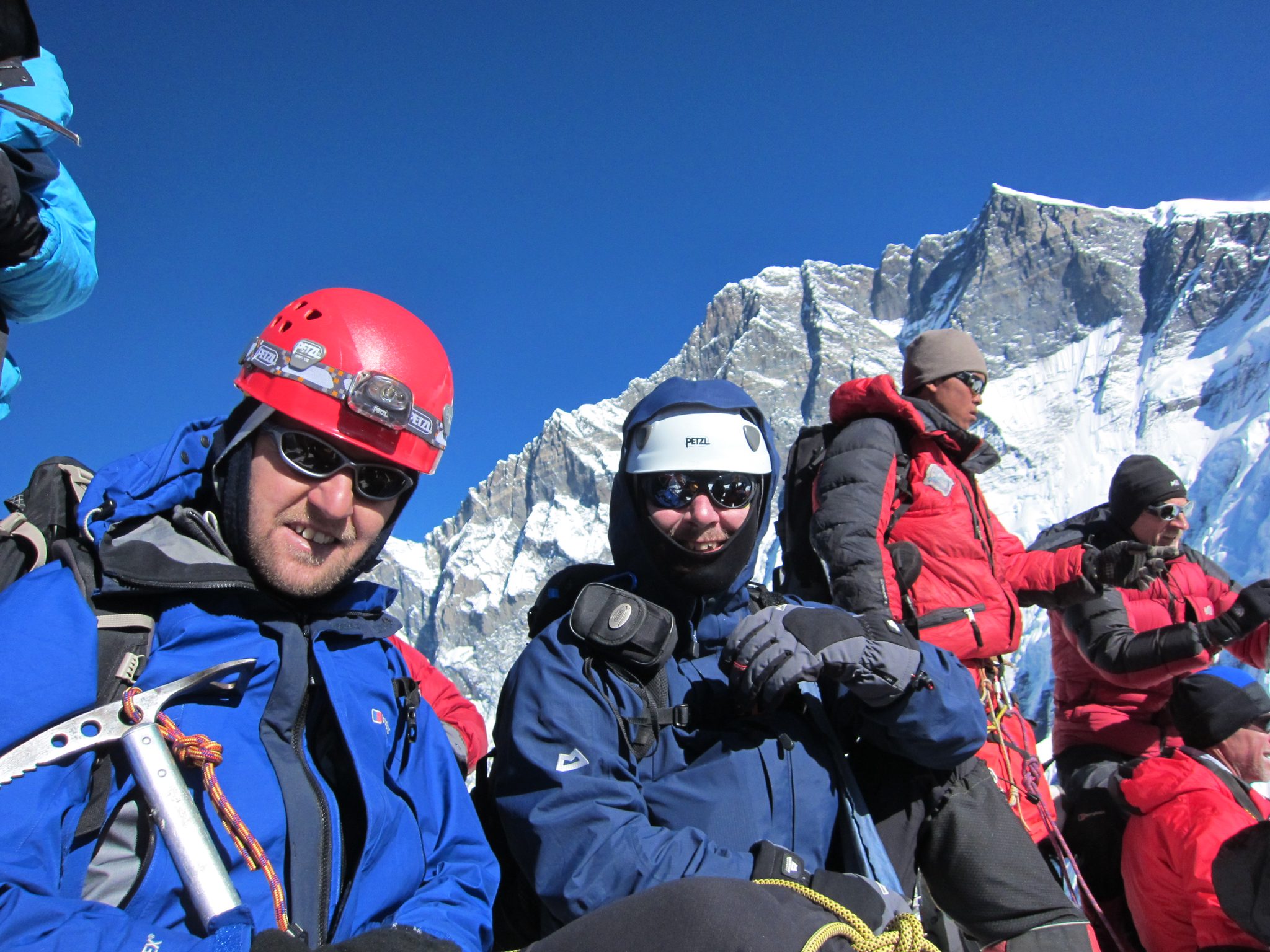
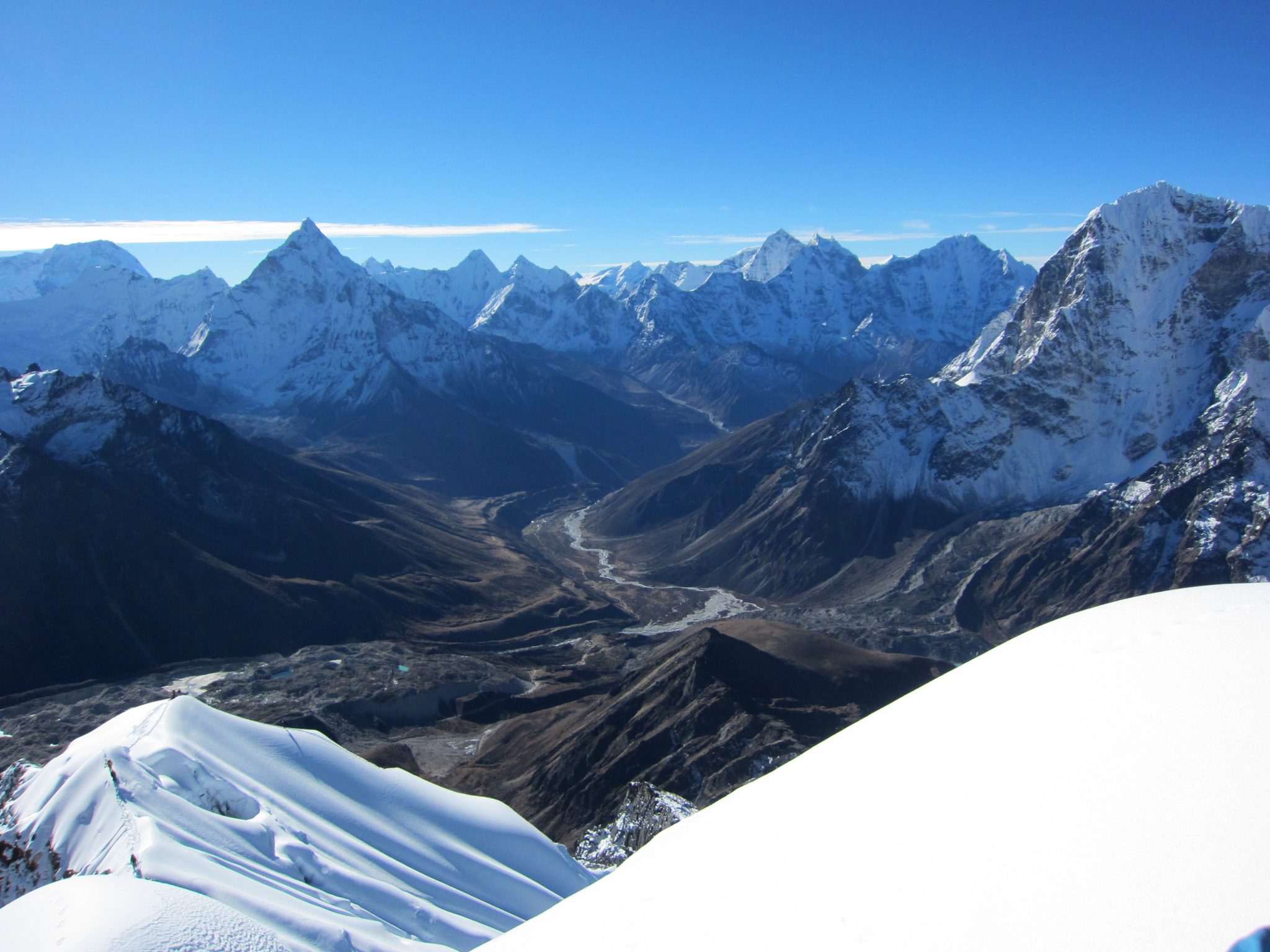
Finally, at about 08:30, all eight of us who’d set off from High Camp had arrived on the summit at 6,189m. The climb had been incredible, with a brilliant mix of scrambling, glacier-crossing, climbing, and finally a knife-edge ridge, all in the shadow of Lhotse’s south face stretching up to 8,501m
After a few photos and some antics with a French group who didn’t appear to have the first idea about safety, we climbed back down the ridge with just a safety karabiner attached and the rope running through our hands, then queued up for the abseil down the headwall.
By this time everyone was exhausted and just wanted to get down, so the mood wasn’t as positive as on the summit. Unlike the climb up, where several people can have a Jumar attached to the same rope, abseiling requires a loose rope below, so only one person can be on each section at a time, and the process seemed to take forever.
I was near the back, with just Thomas and Andy behind me. When we finally got down the fixed line, the three of us roped up for the glacier and wound our way back past the crevasses, which looked way more impressive and daunting in the sunlight than they had by the light of our head-torches.
At the bottom of the glacier we caught up with the rest of the group, removed our crampons, stowed them and the axes, drank as much as we could and set off down the rocks to High Camp. The strain was beginning to show, and Steve ended up giving his gear to Andy, Thomas and me, as he was beginning to suffer. By the time we reached High Camp, Mark was in a bad way too, which was a huge surprise as he’s been the strongest all trip.
We were re-hydrated with drinks and soup back at High Camp, then slowly packed up and began the descent to Base Camp. There was a biting wind blowing up the valley as we walked down, and it was a relief to get back to the shelter of the mess tent, where we were given more drinks. Most of the team had a snooze before dinner, and the banter during dinner was pretty limited. By 19:30 everyone had crashed out.
From my point of view, the contrast between the two climbs couldn’t be bigger. I don’t have any positive memories of Pokalde, but today’s climb is the highest and best I’ve ever done. I’m very relieved I didn’t have any AMS symptoms this time, very pleased to have got to the top of such a challenging climb, and extremely grateful that the weather was so good. To have clear skies and a full moon without the temperature being too bad was an ideal combination.
Finally I’m beginning to remember why we’re paying £3k for this!
Yesterday we dropped down from Island Peak Base Camp, through Chukhung and back to Dingboche. The lodge we stayed in last time was full, so we checked into one with a very welcome warm shower - the first time most of us had had a decent wash since Namche Bazaar ten days ago. This time we even managed to convince Andy to have a shower.
We had lunch sitting outside the lodge, then spent the afternoon relaxing, sending the odd email from the Dingboche internet shed, and making use of the shower.
After days avoiding the crowds, we were back on the Everest Base Camp trail this morning, and I realised how lucky we’ve been the last few days. We’ve paused for lunch in Dughla, a settlement which consists simply of two lodges, feeding about six million trekkers (Acute Mountain Snobbery again).
The route from Dingboche to Dughla took us over the shoulder of the ridge that comes off Pokalde, separating the Imja Khola valley (where we’ve been for the last week or so) from the Lobouje Khola (which leads up to the Khumbu Glacier and Everest Base Camp). As we reached the top of the ridge we passed a little stupa and had our last look back at Island Peak. Someone commented that we could see Lobouje East up the other valley, but I could only see enormous summits with huge rock faces, so assumed they were joking and ignored them. Andy has since confirmed, however, that one of the most ominous-looking is indeed Lobouje. It looks pretty terrifying from what we’ve seen so far, with a huge south face of rock and snow. Several of us have asked Andy about the route, assuming it’s somewhere we haven’t seen yet, like up a nice grassy slope round the back, but it isn’t - it’s straight up the south face.
The summit of Lobouje East, at 6,119m, is 46m lower than Lobouje West, but is a much more common objective as Lobouje West is a considerably harder climb and requires a much more expensive permit. Before the trip, I hadn’t realised that we weren’t going for the main summit, so was slightly surprised to hear that, then was even more surprised to learn that most expeditions don’t even get as far as Lobouje East. At the end of the ridge there is a false summit, which is where most trips stop, as the route to the summit is often too dangerous - Andy had been there in May when there was a massive crevasse blocking the route.
It seems a bit strange having an objective that isn’t the real summit, and not expecting to even make that. Island Peak was much simpler: the objective was just to get to the top. It’ll be great if we reach the summit of Lobouje East, but I’m going to be a bit disappointed if we’re stopped by a crevasse at the false summit.
Having crossed into the new valley, we’ve got a whole new selection of mountains to look at and poor old Ama Dablam, centre of attention for the trip so far, is being ignored. Lobouje is one of the most daunting peaks we can see at the moment and Pumori, which has just appeared round the corner, also looks pretty impressive.
The walk up from Dughla to Base Camp yesterday afternoon took about two hours and, apart from the intial climb out of the settlement, wasn’t particularly strenuous. On arrival we rigged up a zip-wire for Ted, Andy’s teddy-bear, then sorted out the kit for High Camp and drank as much water as possible.
Last night was possibly the coldest night we’ve had so far. Although Rich and I didn’t seem to suffer too much with ice inside the tent, it was the first time I’d slept with my sleeping bag fully done up, with the hood round my head. This morning wasn’t too cold though and we had a pretty relaxed start, with breakfast at 08:00 then some final preparations before setting off for High Camp at about 09:30.
Having felt a bit lethargic yesterday, this morning’s climb up to High Camp was great - I felt really strong, and I just hope I feel like this tomorrow!
We’re down to eight now, as Steve has gone back down to Base Camp. He seemed genuinely worried about his health when I was chatting to him on the way up this morning. I think he was surprised by how weak he felt on the way down Island Peak.
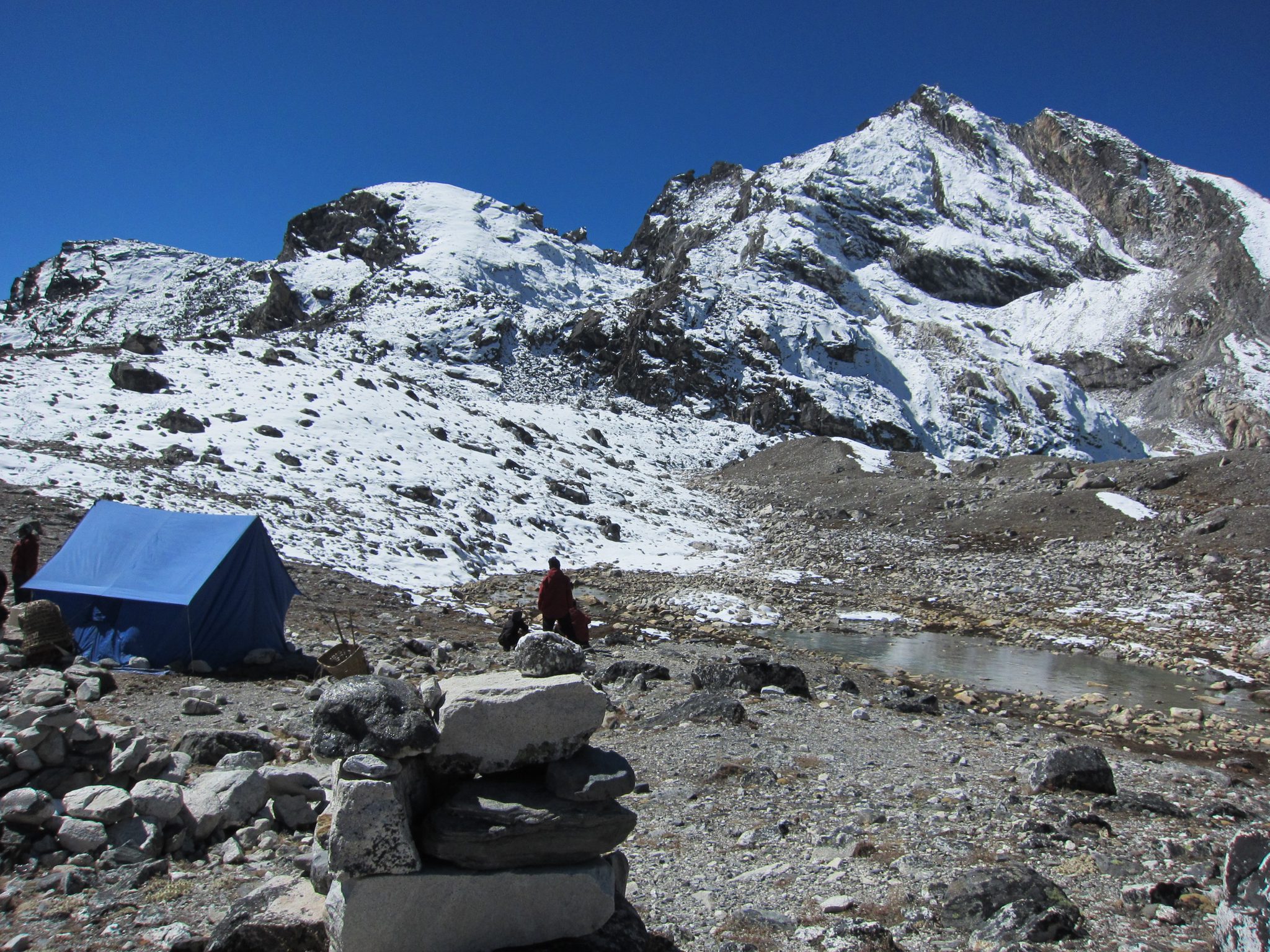
After a minor disagreement regarding the tent arrangements, we’re now settled into High Camp. The location is amazing - a tiny lake on the side of Lobouje, with views of Lhotse, Nuptse, Ama Dablam and Lobouje’s summit. The sky is blue, the sun is shining, and I can’t imagine many better places than this. The only problem is that we have to be up at 01:30 to climb a mountain.
Yesterday afternoon, Dowa climbed up to put the fixed ropes in, and reported back that the route was in good condition and that the summit should be possible. Andy was non-committal when he told us, but I’m sure he’d like to get there too.
We had the usual pre-summit meal in our tents last night: soup and prawn crackers, a rehydrated meal in a bag (salmon and dill sauce this time) then a slice of fruit. While we were eating, the Sherpas filled our water-bottles with boiled water, so we tucked these inside our sleeping bags to keep our feet warm and crashed out at about 19:30.
As a result of Dowa’s assessment, the hot chocolate arrived at 01:00 this morning to give us a bit more time to reach the summit. I haven’t been outside yet but Andy just popped round and reported that it was clear and warm, which is ideal. Right now I’m trying to force down a bowl of porridge, but I’m hoping it will be the last one as I can’t stand the stuff. I need something to get me up the mountain though, and there isn’t a huge amount of choice up here.
After setting off around 02:30, we hit the false summit at about 08:00 then Dowa, Mark, Andy and I reached the real summit at 08:35.
After another incredibly clear and starry night, the wake-up call found us warm and cozy. Despite the clear skies, it was surprisingly warm - below zero, but not as uncomfortable as sometimes.
I’d slept well so it wasn’t too hard getting up, but somehow I still managed to be the last one ready. The porridge arrived at 01:30 and all I has to do was eat, get dressed, clean my teeth, squat over some rocks behind the tent, then get my kit ready, but this seemed to take longer than everyone else so I set off at the back of the group near Thomas and Nima Temba.
The first couple of hours was spent climbing up some amazing slabs of rock, which were covered with more snow and ice as we got higher. This time there were no other groups on the mountain so the only light was the 12 head-torches of our group: 8 clients, Andy and 3 Sherpas. The only noises were the crunch of feet on either rock or snow, the clanking of climbing equipment, and the chanting of Tam Ding and Nima Temba’s prayers.
It was still dark when we reached the glacier at about 04:30. We seemed to get organised more efficiently this time, and the first group to set off was Andy, Mark, Rich and me.
The glacier crossing didn’t seem as circuitous as on Island Peak, but it felt like there was more height gain. By this stage I was feeling the altitude (~5,600m) and wasn’t really enjoying having the pace dictated. The back of a rope-group is an unfortunate place to be, as the leader (who sets the pace) will finish a section of ascent and speed up for the descent while the guy at the back is still climbing, and quite happy with the slower pace.
As we’d been crossing the glacier the sun had started to appear, and there’d been some amazing views across the Himalaya. Unfortunately being roped to three other people isn’t conducive to photography (especially when the batteries are kept separately in a chest pocket to keep them warm), so I don’t have any photos from that part of the climb.
Apart from a brief climb near the beginning, most of the height gain came from a sustained ascent towards the end of the glacier, as we approached the start of the fixed ropes. The slope got steeper and steeper until Andy eventually came to a stop at the line that Dowa had set up. When we’d arrived at the glacier I’d dumped my poles, attached my crampons and tied into the end of the rope with a retied figure of eight. Mark and Rich had clipped into knots at intervals along the rope, and the three of us were reeled in by Andy. We attached our Jumars to the line and set off, leaving Andy behind to speak to the next group, and hoping we’d meet Dowa somewhere higher up.
There were a couple of anchors in the first section, and we generally caught each other at these, as there’s a slight delay while you clip your safety karabiner to the anchor and transfer the Jumar to the next section of rope. Andy was far below, I paused at one of the anchors, put a battery in, and started taking photos.
I was travelling at about the same time as the other two but all three of use were going slowly and stopping regularly. By the time we reached the top of the first section Andy had caught up, and wasn’t best pleased when he saw Mark unattached. There was a 10m gap between ropes and Mark was halfway across the gap, but luckily Dowa was there to explain.
At the top of the second section we reached a little plateau and clipped into an anchor, as the third and final section of fixed ropes wasn’t yet in place. We crossed another short unroped section then Dowa appeared, abseiling down his latest creation. Once he was off we clipped in and began our climb to the false summit.
We clipped into another anchor at the false summit and were soon joined by the second rope party - Dave, Martin and Jo. At this point Andy asked if anyone was interested in carrying on to the main summit but there wasn’t much enthusiasm - only Mark and I showed any interest. Although the fixed lines hadn’t been as steep as Island Peak, they’d been way longer - Andy reckoned 400m of ascent compared to 100m on Island. Climbing this far at 6,000m had taken it’s toll.
Luckily the views were incredible. In one direction we could see Everest poking above the Nuptse-Lhotse ridge, with Makalu slightly off to the right, and in front of Makalu was little old Island Peak.
The summit party was lead by Dowa, with me second, followed by Mark and Andy. The route was along a very sharp, steep ridge, and Andy reminded us to keep the rope tight and concentrate on every single footstep, ensuring we had our axes in the snow before moving our feet.
It took about 30 minutes to reach the summit (6,119m). The journey was exhilarating, exhausting and at times downright terrifying. The steep drops on either side of the ridge sometimes ended at a vertical cliff only a few metres away.
At the summit there were hugs and high fives, and a few minutes for photos. The skies were still clear and the views were even better than from the false summit some 100m lower. There were a few small clouds in the distance though, and Andy said the weather was about to change so we should head down. He gave us another reminder of how dangerous the ridge path was, then we re-traced our steps to the false summit and began abseiling down the fixed lines.
Abseiling is beginning to feel a bit more natural. I hadn’t done much before this trip but I’m getting used to it now, and switching over at anchors is becoming more efficient too.
At the bottom of the fixed lines we roped up for the glacier and I lead Mark and Andy back down to the rock section. We caught up with several others there, but they were just setting off as we stopped for some food and drink, as well as re-arranging our kit and switching from ice-axe and crampons back to poles.
Mark had felt quite unwell after Island Peak and had put this down to keeping his down jacket on too long, so I’d been gradually shedding layers. Once the sun had appeared it was too hot for a down jacket so I’d stowed that at the false summit then lost my Primaloft jacket as we reached the rock.
We slowly dropped down across the enormous slabs back to the little lake where high camp was perched and I suddenly began feeling dehydrated and absolutely exhausted. We were given hot lemon then soup to help us rehydrate, then I crashed out in the tent for a bit. Unfortunately the porters wanted to move everyone down to base camp as soon as possible, so the rest of the team began packing up and shipping out. Rich and I were last, but finally got our kit sorted out and slowly plodded down to base camp, where we were fed more hot lemon while the tents were put up, then we all crashed out again.